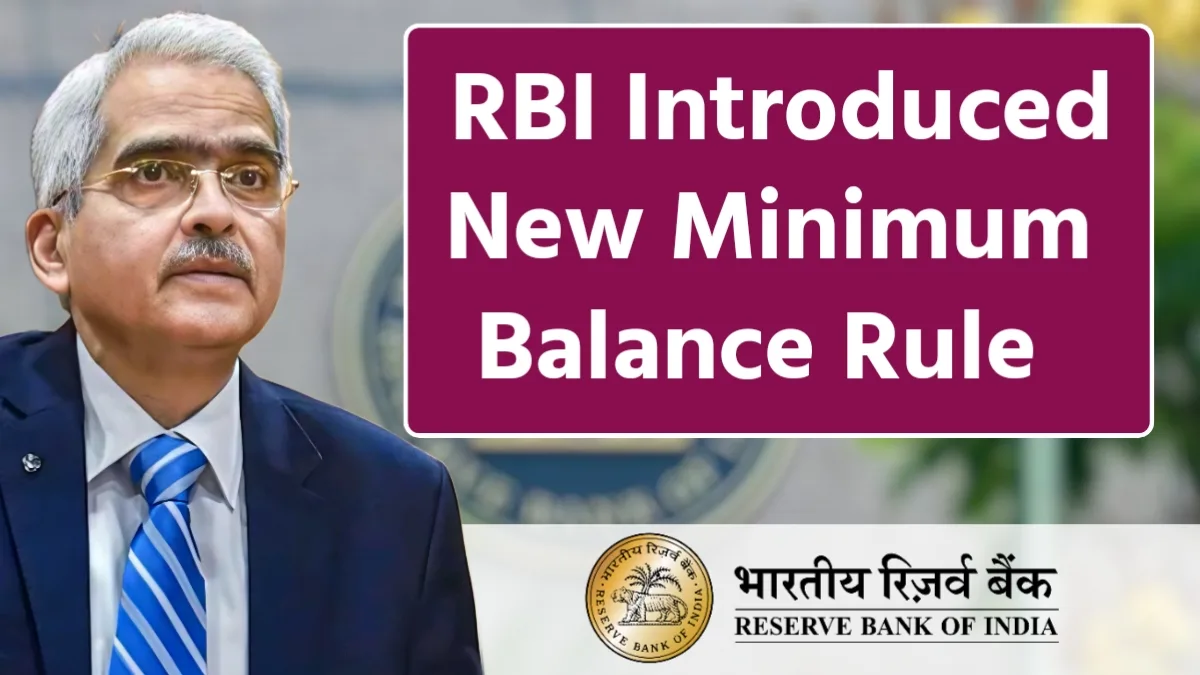
New RBI Minimum Balance Rules: The Reserve Bank of India (RBI) has announced a revised framework for minimum balance requirements in savings and current accounts, expected to take effect from March 15 2026. The development has brought renewed attention to how banks calculate and enforce average monthly balance norms across metro, urban, semi-urban and rural branches. According to reports, the move is aimed at reducing confusion caused by differing rules across locations and banking institutions.
For years, account holders have navigated a patchwork of policies often discovering variations only after incurring penalties. As per guidelines, the new structure seeks to standardise broad benchmarks while improving transparency in communication. In practical terms, this means customers may experience more predictable balance expectations, although final implementation will still depend on individual bank policies. With digital banking usage rising rapidly, the timing of this revision signals an effort to align traditional banking norms with current financial behaviour.
Uniform Minimum Balance Benchmarks Across Regions
Based on available information, savings account holders in metro and urban areas may be required to maintain an average monthly balance of approximately ₹3,000. In semi-urban and rural locations, the proposed threshold is expected to be around ₹1,500. The differentiated structure reflects income patterns and cost-of-living variations across regions while attempting to bring consistency to the broader system.
Current accounts, which are widely used by businesses and traders, may face higher balance expectations depending on account type and transaction volume. Earlier, minimum balance rules often varied significantly between banks and even across branches of the same bank. According to reports, the RBI’s revised framework is designed to reduce such disparities, though penalty slabs and specific service features may still differ from one institution to another.
Why the RBI Is Revisiting Legacy Banking Norms
India’s banking ecosystem has undergone rapid transformation with the expansion of digital payments, Unified Payments Interface (UPI) transactions and app-based account management. Despite these shifts, minimum balance calculations in many banks continued to follow older branch-based models. Regulators reportedly observed an increase in customer grievances related to unexpected deductions and unclear average balance formulas.
A senior banking analyst noted that standardisation was “a natural progression in a digital-first financial environment where customers operate across cities and platforms.” The updated approach may improve disclosure standards and reduce disputes, especially when customers relocate or open multiple accounts. However, its success will depend largely on how effectively banks communicate revised norms to their account holders.
Impact on Salaried Individuals, Students and Small Businesses
For salaried professionals maintaining stable monthly inflows, holding a few thousand rupees as an average monthly balance may not significantly disrupt budgeting. However, students, pensioners and small traders working with variable cash flows could feel the adjustment more closely. Even modest penalty charges, if applied repeatedly, may gradually affect monthly finances. This may vary by case depending on transaction patterns and account usage.
Consider a freelance graphic designer who keeps separate accounts for project payments, savings and subscription services. If automated debits reduce the balance below the required threshold mid-month, penalty charges may apply under bank rules. Similarly, rural households with seasonal income—such as agriculture-based earnings—may find it challenging to maintain a uniform average balance throughout the year.
Comparison With Earlier Practices in Public and Private Banks
Historically, public sector banks tended to maintain relatively lower minimum balance requirements, while private lenders often imposed higher thresholds in metropolitan branches. Penalty calculations also differed, sometimes based on percentage shortfalls rather than fixed slabs. Customers who shifted jobs or cities frequently encountered new rules without clear advance notice.
The 2026 framework indicates a gradual shift toward more customer-centric regulation. Supporters argue that broader standardisation may reduce hidden or unexpected deductions and bring greater clarity. Critics, however, suggest that uniform benchmarks could limit banks’ flexibility in designing differentiated products. The long-term impact will likely become clearer once the revised norms are operational and customer feedback is assessed.
Digital Alerts and Zero-Balance Account Options
Parallel to tightening balance norms, banks are promoting basic savings accounts that do not require a minimum balance. These accounts, often linked to financial inclusion initiatives, provide essential services but may limit the number of free transactions. Younger users comfortable with mobile banking are increasingly exploring digital-only products that sometimes feature lower maintenance requirements.
According to available documents, many banks are strengthening real-time notification systems that alert customers when balances approach the prescribed minimum. In practical terms, such alerts may help prevent avoidable penalties. However, verification is recommended because transaction timing, cheque clearances and scheduled debits can influence average monthly calculations.
Communication and Compliance Before February 2026
Banks are expected to inform customers about revised requirements through SMS, email notifications and mobile app updates. Account holders managing multiple accounts may consider reviewing unused or dormant accounts and reassessing standing instructions to ensure adequate monthly averages. Consolidating rarely used accounts may reduce administrative complexity.
Senior citizens, students or holders of specific basic savings products may qualify for relaxed conditions in certain cases. As per guidelines, exemptions may vary depending on bank category and account type. Checking monthly statements, enabling low-balance alerts and reviewing official bank notifications are practical steps customers can take before the changes come into force.
Broader Implications for India’s Banking Discipline
The revision reflects a broader effort to streamline retail banking operations amid expanding digital adoption. In recent years, banks have focused on fee rationalisation and cost optimisation as transaction volumes increased. Establishing clearer minimum balance norms may support operational predictability while reinforcing financial discipline among account holders.
At the same time, experts caution that enforcement must remain sensitive to financial inclusion goals. India’s banking expansion has relied heavily on bringing first-time users into the formal system. Any framework that increases compliance pressure without adequate communication may risk discouraging low-income customers. Balancing transparency with accessibility will therefore remain essential.
Clarification on Average Monthly Balance Calculation
It is important to note that minimum balance requirements generally refer to the average monthly balance (AMB), not simply the closing balance on the last day of the month. The AMB is typically calculated by summing daily end-of-day balances and dividing by the number of days in the month. Customers sometimes misunderstand this distinction, leading to unintended shortfalls.
For example, maintaining ₹5,000 for the first half of the month but allowing the balance to drop significantly in the second half could reduce the overall average below the required threshold. This clarification becomes especially relevant as the revised norms approach implementation. Understanding the calculation method may help account holders avoid charges that could otherwise accumulate.
What Account Holders Should Watch Going Forward
While the broad benchmarks appear clear, individual banks retain authority to define specific penalty slabs, grace periods and service benefits linked to different account categories. Therefore, the practical impact may differ across institutions. According to reports, customers should expect detailed circulars closer to the effective date outlining operational procedures.
Verification is recommended before making financial adjustments solely based on general news updates. Customers may consult official bank websites, branch representatives or customer care channels for confirmation. In practical terms, proactive monitoring rather than reactive response may be the most effective way to adapt to the revised RBI minimum balance rules once they become operational.
Disclaimer: This article is based on publicly available information and emerging updates regarding banking regulations. Minimum balance thresholds, penalty structures and exemptions may change or vary by bank and account category. Readers are advised to confirm details directly with their respective banks or refer to official notifications before making financial decisions.